

SIRIS Spine Implant Registry
-
1. Data Registration Obligation
-
2. Inclusion Criteria
-
3. Implant Registration
-
4. Data Quality
-
5. Registry Logistics
-
6. Reporting Forms
-
7. Further Information
1. Data Registration Obligation
All hospitals and clinics participating in the ANQ National Quality Agreement and performing surgeries subject to registration are required to register data.
LINK to SIRIS Spine data entry
2. Inclusion Criteria
Included since january 2025
• all surgeries performed in Switzerland and the Principality of Liechtenstein
• for patients aged 18 and older,
• who speak German, French, Italian, or English and have consented to data processing in the SIRIS Spine Implant Registry after receiving information about it.
All surgeries must be registered if an implant in the lumbar spine (LSP)
a) is newly inserted (new implantation),
b) remains in place (reoperation or revision without replacement), or
c) is removed (explantation with or without replacement). c) explantiert wird (Explantation mit oder ohne Wechsel).
Explanatory notes
These inclusion criteria cover all implant-related surgeries on the lumbar spine. This also includes extensive surgeries (primary surgeries, reoperations, or revisions) that extend beyond the lumbar spine (for example, extension of instrumentation or spondylodesis to the thoracic spine or pelvis), in which an implant is newly inserted, remains in situ, or is explanted in the lumbar spine. In addition, all reoperations or revisions following a spondylodesis are included, such as wound revisions or isolated decompressions in the adjacent segment, even if the implants remain unchanged.
Examples of surgeries subject to registration
• XLIF, OLIF, ALIF, TLIF, PLIF, vertebroplasty, kyphoplasty
• Intervertebral disc prosthesis, elastic rods, interspinous spacers, or spondylodesis
• Corrective spondylodesis Th10-S2-ilium
• Lengthening spondylodesis and/or decompression Th11/12 following spondylodesis
• Th12-ilium
• Revision with decompression alone for stenosis following lumbar spondylodesis (regardless of the timing of the primary surgery) at the same or adjacent segment
• Revision with wound debridement for stenosis following lumbar spondylodesis
• Revision with metal removal for stenosis following lumbar spondylodesis
3. Registration of Implants
Implants are defined as all products that can be implanted in the spine and remain permanently in the body. These include, among others, cement and bone substitute products. However, products that do not remain permanently in the body, such as local hemostatic agents (Tachosil) or guide wires for screw placement, are not considered implants.
Implants are registered based on an implant catalog, which is also used in the international Spine Tango Registry. This catalog is continuously updated with product specifications provided by medical device companies.
Implant data can be scanned, added from the favorites list, or uniquely identified by their part number (also referred to as a reference or product number) and added to the case. Alternatively, a keyword search is possible.
Implants that cannot be found can be reported and added to the catalog.
4. Data Quality
All relevant data is recorded in a structured format using predefined response options or within permitted value ranges. Plausibility checks are performed during data entry. These validation rules are continuously refined in collaboration with the SIRIS Spine Scientific Advisory Board.
Verification of Registered Surgery Numbers Using CHOP Codes
Internal and external verification of the registered surgery numbers is possible using CHOP codes. Coding is performed in accordance with the relevant guidelines of the Federal Statistical Office. For information on the guidelines for CHOP code 7A.6, see, for example, the Circular for Coders 2024 No. 1 - Applicable to cases with a discharge date on or after January 1, 2024 | Publication | Federal Statistical Office (admin.ch) (LINK).
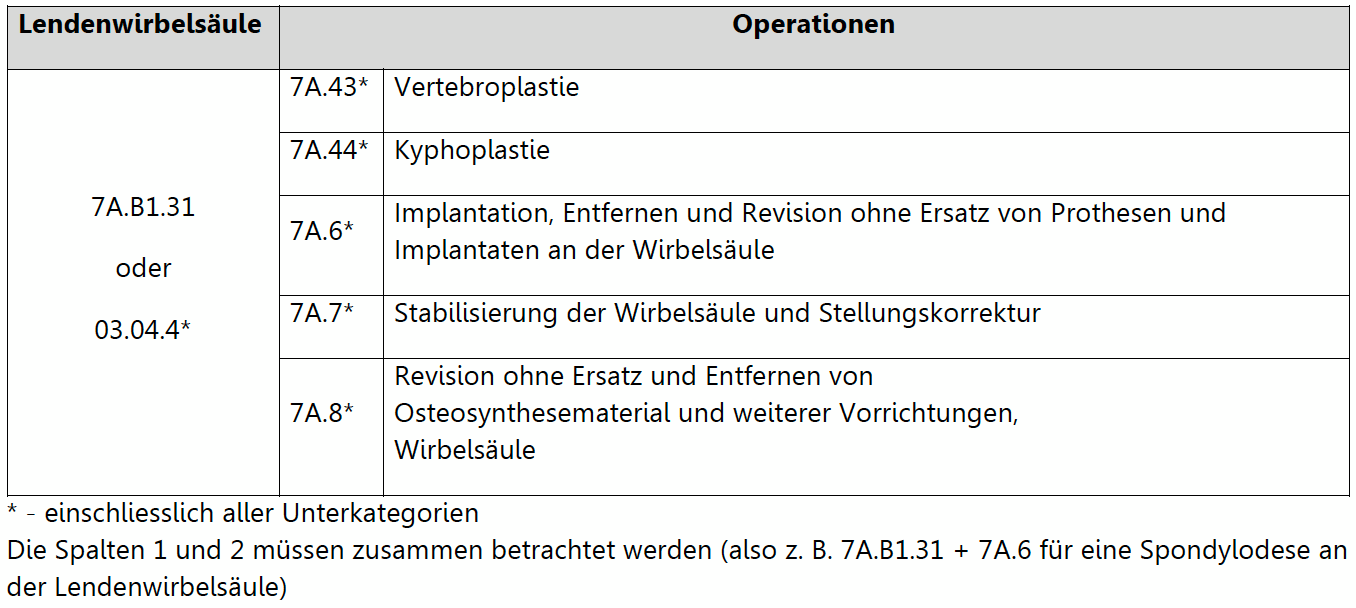
Combinations of CHOP codes relevant to the SIRIS Spine Implant Registry.
Primary surgeries
Using CHOP codes 7A.43*, 7A.44*, 7A.6*, 7A.7*, and 7A.8* in combination with CHOP code 7A.B1.31 or 03.04.4* for the lumbar spine, all primary surgeries subject to registration as well as most revisions and reoperations can be identified and matched with registered surgeries (see Table).
Reoperations and Revisions
The challenge in reviewing data lies in a small proportion of revisions performed on the same and/or adjacent segments that were coded as primary procedures (such as decompression) and therefore cannot be identified using the CHOP codes mentioned above. Their coding may vary. Currently, there is no CHOP code that codes implants in situ and indicates a connection between the initial and subsequent surgeries on adjacent segments. For this reason, these types of revisions cannot yet be easily verified using CHOP codes alone.
However, among patients with the CHOP codes listed above, it is possible to identify those who underwent a subsequent surgery (for example, using a duplicate patient ID in an Excel spreadsheet). These subsequent surgeries can then be reviewed individually to determine whether they were performed on the same or an adjacent segment and thus fall under the registry’s inclusion criteria.
We ask hospitals and clinics for your support in this regular review of surgery counts to ensure a high capture rate in individual hospitals and clinics as well as in the registry as a whole. The SIRIS Foundation has applied to the Federal Statistical Office for new, more specific CHOP codes to close this validation gap.
Upon request, the registry team provides hospitals and clinics with a semi-automated spreadsheet template for verifying surgery figures.
On-site Monitoring
Since 2025, on-site monitoring has been conducted at hospitals and clinics. During these visits, the local processes and responsibilities relevant to registration, as well as a sample of surgeries, are reviewed together with the individuals involved. Hospitals and clinics are supported in identifying optimization measures.
5. Registry Logistics
The SIRIS Spine registry platform is specifically designed for the collection and analysis of data related to treatments involving medical devices. The platform is configured to meet specific requirements and uses a shared implant database with EUROSPINE’s Spine Tango.
SIRIS Spine and Spine Tango also use the same core dataset. While both registries are maintained independently of one another, there are significant advantages to close collaboration:
• Shared, proven registry platform and database for implants
• Further development of functionalities is available to both registries simultaneously
• Rapid attainment of statistically robust findings through data pooling
• Existing document templates (study protocol template, user documentation, etc.)
• No duplicate data entry for Swiss Spine Tango clinics
Users of the SIRIS Spine implant registry can be divided into two groups:
Group A: those who document only the content of SIRIS Spine.
Group B: those who document the content of SIRIS Spine and the remaining Spine Tango variables, as well as any other forms (such as Oswestry, NDI, medical follow-up, conservative treatment, etc.).
In Switzerland, both user groups use a single data entry point—the SIRIS Spine Implant Registry. Access is restricted to registered and authorized users.
6. Reporting Formats
Quarterly Reports
Quarterly reports are provided to hospitals and clinics in a standardized format (including benchmarking). The content of these reports is continuously refined.
Annual Report
Once a year, a comprehensive SIRIS Spine annual report is compiled and published. (LINK).
7. Further Information
Regulations, manuals, and guidelines, as well as all survey forms and reports, can be found under Downloads on this website.
If you have any further questions, please feel free to contact us as follows:
Registry Operations and EUROSPINE
siris-spine@eurospine.org
for support of the SIRIS Spine
077 500 34 66
SIRIS Foundation
Jasmin Vonlanthen
jasmin.vonlanthen@siris-implant.ch
ANQ
Olivier Pahud
olivier.pahud@anq.ch